Which Hiking Trails Are Best in Udzungwa?
The best trail in Udzungwa Mountains National Park depends on what you came for: Sanje Waterfall for the scenery, Njokamoni for endemic primates, Hidden Valleys for a full day of wild country, and Mwanihana for multi day trekking. All routes start at the Mang’ula headquarters with a compulsory guide. Udzungwa is a rainforest park in south central Tanzania with no interior roads, so every trail here is walked rather than driven.
Trails range from twenty minute strolls to the 65 kilometre Lumemo route over five days. Choosing badly is the main way people waste a visit here.
Sanje Waterfall Trail: The Best All Round Hike
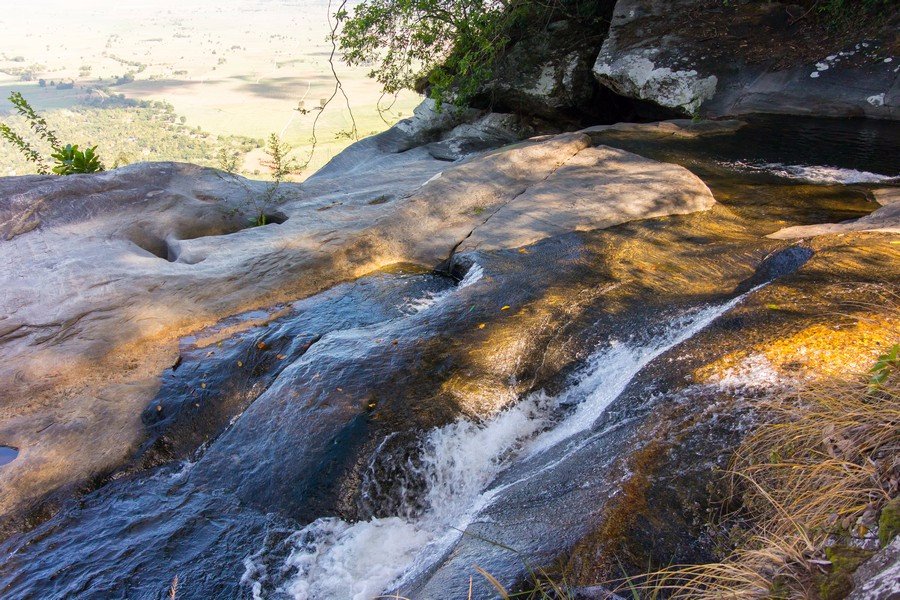
If you walk one trail, walk this one. The Sanje Waterfall trail runs four to six hours return over roughly three and a half to six kilometres, climbing about 450 metres to a fall of around 170 metres in three tiers. A viewpoint two thirds of the way up opens over the Kilombero floodplain, and there is a swimmable plunge pool at the upper tier.
Both colobus species are commonly seen along it. At the right time of year the sides of the gorge fill with fireball lilies. A twenty minute detour reaches the base of the largest drop, where the pool is warmer and people jump in from the rocks.
It is also the busiest path in the park, which by Udzungwa standards means you might pass two other groups.
Njokamoni Trail: The Best Trail for Endemic Primates
Similar in length and altitude to Sanje at around six and a half kilometres, four to five hours return, with a waterfall and bathing pool at the top. The difference is traffic. Almost nobody walks the Njokamoni trail, and troops of Sanje mangabey feed close to it as a result.
That endemic monkey is shy and usually invisible on the busier route, so this is the strongest day walk in the park for anyone whose priority is primates. Red duiker, squirrels and elephant shrews turn up along the way. The trail starts at the headquarters and ends on the road about a kilometre below the forest camp, so arrange the pickup before setting off.
Hidden Valleys Circuit: The Best Full Day Trek
The longest single day walk in the park at around seventeen kilometres, six to seven hours, climbing above 1,300 metres. What looks from below like a single ridge turns out to be a step into a system of shallow valleys where streams flatten and meander through open grassy ground.
You follow elephant trails down towards the Moyer River, cross it several times, and can detour to the Moyer waterfalls. Part of the descent passes through ground burnt years ago where the canopy has gone and the path is easy to lose. An armed ranger is required because elephant and buffalo use the clearings. Also called the Campsite 3 circuit, and it finishes near that site by the road.
Mwanihana Trail: The Best Multi Day Trekking Route
Thirty eight kilometres over two or three days from Sonjo village, climbing from about 300 metres to a ridge near 2,150. The Mwanihana trek crosses miombo woodland, lowland forest, grassy plateau, submontane and montane forest, bamboo glades and heather at the summit, which is more habitat variety than any other route in the park delivers.
Camping is at Njia Panda around 900 metres and higher sites beyond. A guide, an armed ranger, porters and a cook come as standard. Elephants are seen on this trail with some regularity, and it is one of the better routes for the Sanje mangabey.
Sonjo Trail: The Best Short Walk for Families
Three kilometres with only 120 metres of gain, taking one to two hours, reaching the base of the first waterfall in about twenty minutes and the second fifteen minutes beyond that. From the upper fall you can cross the water and take a short steep pull to a ridge, descending on a different path that rejoins the road within twenty metres of the first.
Gentle enough for children of six or so, with two cascades and shallow pools at the end. It doubles as the first section of the Mwanihana route, and it works well as a second walk on the morning you leave.
Prince Bernhard Falls Trail: The Best Quick Option
About a kilometre from the headquarters and roughly thirty to forty five minutes return, with a modest height gain. Named for the Dutch prince who opened the park in 1992 and who, at eighty four, could not manage the Sanje climb.
Baboons are frequently seen along it and red colobus feed in the canopy above. You can extend the walk by around a kilometre and a half up to campsite two for more forest without a real climb. This is the trail to take on an arrival afternoon, since the same 24 hour permit will still be running the next morning.
Lumemo Trail: The Longest Route in the Park
Sixty five kilometres over four or five nights, starting beyond Ifakara on the Lumemo River and returning along the same ground as the Mwanihana route not far from the forest camp. It is the most demanding established trail here and the least walked.
Everything is carried, camps are wild, and the crew includes a ranger, porters and a cook. This is expedition trekking rather than hiking, and it needs arranging weeks ahead. Anyone tempted by it should have done consecutive days on trail before.
Comparing the Main Udzungwa Hiking Trails
Two other routes appear on the park’s list and see very little use: Mzimu at around sixteen kilometres and Njia Panda at twenty six. Ask about them if you are staying several days and want something nobody else is walking.
How to Combine Trails Across Two or Three Days
Two nights at Mang’ula is the shape most visitors settle on. Prince Bernhard on the arrival afternoon, Sanje the following full day, Sonjo on the morning you leave. That covers three waterfalls, a valley viewpoint and several primate species without a single hard day.
Three nights lets you swap the last morning for Njokamoni or Hidden Valleys, which is where the park stops feeling like a stop on a route and starts feeling like a destination. Watch the permit clock while you plan, since the conservation fee runs 24 hours from payment rather than to closing time, and a well timed arrival can get two walks onto one fee.
Best Time of Year for the Udzungwa Trails
June through October is the window when every route is available. The shorter trails work year round, while the higher circuits and multi day treks become difficult during the long rains from March to May.
Getting to the Trailheads
All walking starts with registration at the headquarters at Mang’ula, on the road between Mikumi town and Ifakara, where fees are paid and a guide assigned. Prince Bernhard and Njokamoni begin there. Sanje is a few kilometres north near Sanje village and reached by tuk tuk. Sonjo village, which also serves the Mwanihana route, lies a short transfer beyond.
Mang’ula is five to six hours from Dar es Salaam via Chalinze, Morogoro and the highway through Mikumi National Park, and around 60 kilometres from Mikumi itself. Iringa is two to three hours southwest. The TAZARA train stops at Mang’ula station and Ifakara buses pass the gate.
Frequently Asked Questions About Udzungwa’s Trails
How much does it cost to hike in Udzungwa?
Non resident adults pay a conservation fee of 30 US dollars per person for 24 hours, roughly 35.40 with value added tax, covering every day trail walked in that window. A compulsory guide adds around 20 dollars per day, charged per guide rather than per person, and an armed ranger a similar amount on the routes that need one. Some operators quote a full day guided rate near 50 dollars per person. Multi day treks run 400 to 500 dollars per person.
Which trail should I choose with only one day?
Sanje Waterfall, comfortably. It gives you the biggest waterfall in the park, a swimming pool, a valley viewpoint and good odds on two colobus species in a single morning. If four to six hours of climbing is too much, the shorter lower falls option takes two to three hours.
Can I walk without a guide?
No. Every trail in Udzungwa requires a licensed park guide with no self guided option anywhere, and the higher routes also require an armed ranger because of elephant and buffalo. Guides are assigned at the headquarters when you register, and on some trails they also arrange the pickup point.
Which trail is best for birdwatching?
The Eastern Arc specialists live high, so Hidden Valleys or a leg of the Mwanihana trek beat the waterfall walks. For general forest birding the Njokamoni and Prince Bernhard trails are productive early in the morning, and the camp grounds on the boundary have recorded over eighty species on their own.
Can I do two trails on one permit?
Yes, if they fall inside the same 24 hours. The usual combination is a short walk on the arrival afternoon and a longer one the following morning. Two four hour trails in one day is possible in theory and unpleasant in practice.
Are the trails marked?
Partly, and not reliably. Sections through grassland grow over between seasons and junctions are not always obvious, particularly on the Hidden Valleys route where old fire damage has left ground cover riddled with elephant tracks. Guides navigate and carry radio contact with the headquarters.
Booking Your Udzungwa Trip
The safari companies and tour operators listed on this website put trips like this together for a living and know which camps, guides and routes actually deliver. We are an independent guide to Udzungwa; we do not book or sell tours ourselves.
When you are ready, arrange your safari, tour or holiday with one of the recognised operators listed here. Tell them your dates and what matters most, and a real person, not a form, will handle the itinerary, park bookings and logistics for you.