Red Colobus Tracking in Udzungwa National Park
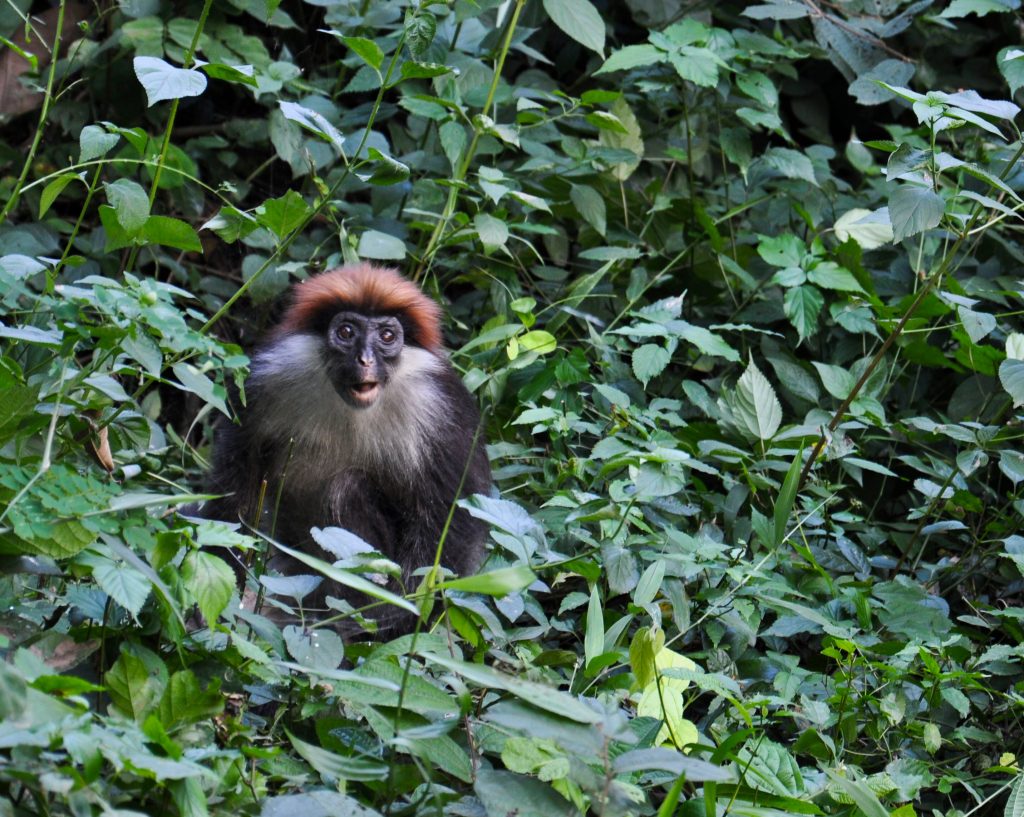
Red colobus tracking in Udzungwa Mountains National Park is a guided forest walk in search of the Udzungwa red colobus, a monkey found in this mountain block and nowhere else on earth. No special permit exists, so the standard park fee and a compulsory guide cover it, with troops most often found on the lower forest trails from the Mang’ula gate. Udzungwa sits in south central Tanzania and holds twelve primate species across its altitude range.
Unlike gorilla or chimpanzee tracking elsewhere in East Africa, this is not a permitted, timed activity with a habituated group. You walk, you look up, and most people find them.
The Udzungwa Red Colobus and Why It Matters
Piliocolobus gordonorum, also called the Iringa red colobus, wears a spiky crown of red hair over black and white body fur, which makes it unmistakable once seen. Total population estimates run between thirty and forty thousand, with the majority inside the national park.
It is listed as endangered, and the reason is habitat rather than numbers. The species is considerably more common in low elevation forest than in high montane forest, and low ground is the ground people farm. Several small lowland patches across the Kilombero Valley outside the park have been badly damaged or lost outright in recent decades, which is why a monkey with tens of thousands of individuals still carries a threatened listing.
How a Red Colobus Tracking Walk Works
Register at the park headquarters, pay the conservation fee and a licensed guide is assigned on the spot. No advance booking is needed. Tell the guide at the start that primates are the priority, because the route and the pace both change accordingly.
From there it is a matter of walking slowly through the right altitude band and stopping often. Guides know which stretches of canopy troops have been using that week, which is information no map carries and the main thing you are paying for. A red colobus tracking walk is usually folded into one of the standard trails rather than sold as a separate product.
Which Trails Produce the Best Sightings
All the short routes work, because they cross the lower forest the species prefers. Prince Bernhard, about a kilometre from the headquarters and under an hour return, regularly produces troops overhead along with baboons on the path. The Sonjo circuit at three kilometres adds miombo edge where certain primates drop down to feed for part of the day.
On the longer routes, the lower half of the Sanje Waterfall trail is the productive section, and it commonly delivers both colobus species on one walk. The Njokamoni trail, four to five hours and walked by almost nobody, gives quieter viewing and doubles the chance of a Sanje mangabey alongside.
Watching Red Colobus Without Walking Anywhere
The solar powered camp on the park boundary sits directly against the forest edge, and troops move through the grounds regularly. Four primate species are recorded there, and guests have reported watching three from the restaurant.
Early morning and late afternoon are when the troops come through. For anyone who cannot manage a long walk, or who simply wants to sit still with binoculars and a coffee, this is the easiest red colobus viewing available anywhere in the range. Over eighty bird species have been logged on the same site, so an unhurried morning on the lawn is a legitimate use of a day here rather than a wasted one.
Colobus Behaviour and What You Will Actually See
Colobus rely on stillness rather than flight, so a troop that has registered you will often carry on feeding twenty metres up while you stand underneath. That is when patience pays. Give it ten minutes and individuals move into the open, groom one another and cross between trees.
Their vocal range is wide and mostly unexplained by science. Adults and juveniles give a sharp call directed at human observers, alongside barks, yelps, squeals and quavers whose functions remain unknown. Red colobus have been recorded moving alongside Angolan colobus, Sykes monkeys, yellow baboons, kipunji and Sanje mangabey, so a troop is often not travelling alone.
Tracking Red Colobus at Magombera Nature Forest Reserve
Below the mountains at the eastern foot of the range, the lowland forest at Magombera holds one of the healthiest red colobus populations outside the park. It was de-gazetted in 1980 and sold to a sugar company, then finally protected as a nature forest reserve in 2019 after roughly forty years of research and campaigning.
The five kilometre Mbega Trail is entirely flat and shaded, and both red colobus and Angolan colobus are relatively habituated there. Decades of living beside people without being hunted, thanks partly to local taboos, mean the monkeys watch visitors from their perches rather than moving off. Part of every entrance fee goes directly to the surrounding villages under a joint management arrangement, and visits need arranging in advance.
How to Track Responsibly
These are unhabituated animals inside the national park, so behaviour changes what you see more than equipment does. Stop when the guide stops and stay stopped longer than feels natural. Keep voices low. Avoid pointing directly at animals, which some species read as a threat.
Give troops room when they cross the path rather than pressing closer for a photograph, and never feed anything. At Magombera the monkeys are calmer and the same courtesies apply, since that tolerance took decades to build and is not worth spending.
Comparing Red Colobus Tracking Options
What Else Turns Up on a Tracking Walk
Red colobus rarely travel alone through the day. Angolan black and white colobus occupy the same forest and sit motionless high in the taller trees, easy to walk under without noticing. Blue monkeys move faster and lower through the understorey. Yellow baboons work the edge near the road and the villages.
Beyond primates, the same trails produce red duiker crossing low down, squirrels on the trunks and sengis bolting through leaf litter. Hornbills cross overhead with a wingbeat you hear first. Butterflies gather at damp ground along the stream crossings in dozens of species. A morning spent looking for one monkey usually hands you a good deal else, which is worth remembering on the days when the troop stays quiet.
Best Time for Red Colobus Tracking
Any month works, since the species lives at low altitude where trails stay walkable year round. Time of day matters far more than season: primates feed hardest in the first hours after dawn and go quiet through the middle of the day.
At Magombera, late May to August is described as the best window, when the forest is cool and dry.
Getting to Udzungwa for Primate Tracking
Register at the headquarters at Mang’ula on the road between Mikumi town and Ifakara. Dar es Salaam is five to six hours away via Chalinze, Morogoro and the highway through Mikumi National Park, with graded dirt for the last 24 kilometres from Kidatu. Mikumi is around 60 kilometres north and Iringa two to three hours southwest.
Magombera lies in the lowlands nearer that road, so it folds neatly into an arrival or departure day. The TAZARA train stops at Mang’ula station and Ifakara buses pass the gate.
Frequently Asked Questions About Red Colobus Tracking
How much does red colobus tracking cost?
There is no tracking permit as there is for gorillas or chimpanzees. You pay the park conservation fee of 30 US dollars per person for 24 hours for non resident adults, roughly 35.40 with value added tax, plus a compulsory guide at around 20 dollars per day charged per guide rather than per head. Children between five and fifteen pay about 10 dollars. Magombera charges its own lower entrance fee.
How likely am I to see them?
Very likely. This is the most commonly seen primate in the park, present on every lower altitude trail and often in the grounds of the camp on the boundary. Most visitors spending a morning walking see them. As with all wildlife, nothing is guaranteed.
Do I need to book tracking in advance?
Not inside the national park, where guides are assigned at the headquarters on arrival. Magombera does need arranging ahead, since it is managed separately by the Tanzania Forest Service alongside local villages rather than by TANAPA.
How do I tell red colobus from the other colobus?
Colour and behaviour. The red colobus has a spiky red crown over black and white fur, while the Angolan black and white colobus is black with long white shoulder fringes and a white tail tip. The black and white species also sits motionless for much longer, which is a fair clue in itself.
Is there a time limit like gorilla tracking?
No. There is no one hour rule and no group size cap, because the animals are not habituated and no permit system applies. You stay as long as the troop does and as long as your walk allows, which in practice tends to be ten or twenty minutes before they move on.
Can children come on a tracking walk?
Yes, on the short trails. Prince Bernhard at under an hour and the Sonjo circuit at one to two hours both suit children from around six, and the flat trail at Magombera works for almost any age. Quiet children see more, which is worth explaining before setting off.
Booking Your Udzungwa Trip
The safari companies and tour operators listed on this website put trips like this together for a living and know which camps, guides and routes actually deliver. We are an independent guide to Udzungwa; we do not book or sell tours ourselves.
When you are ready, arrange your safari, tour or holiday with one of the recognised operators listed here. Tell them your dates and what matters most, and a real person, not a form, will handle the itinerary, park bookings and logistics for you.