What Conservation Projects Operate in Udzungwa?
Conservation work around Udzungwa Mountains National Park runs through several organisations at once: the Udzungwa Ecological Monitoring Centre at Mang’ula, the Udzungwa Forest Project, Reforest Africa, the Tanzania Forest Conservation Group and TANAPA’s own buffer zone programmes. Visitors fund part of it directly through park fees. Udzungwa sits in south central Tanzania and protects the largest forest block in the Eastern Arc chain, one of the world’s recognised biodiversity hotspots.
This is one of the most intensively studied forests in Africa. Walk any trail and there is a reasonable chance the guide beside you has been trained through one of these programmes.
The Udzungwa Ecological Monitoring Centre at Mang’ula
The monitoring centre sits at Mang’ula near the park headquarters and has been running long term biodiversity work since the mid two thousands, producing a decade report covering its first ten years from 2006.
Its output is the backbone of what science knows here. Camera trapping across the forest blocks, standardised surveys, published checklists for the mammals, the birds of Mwanihana forest, the butterflies of the park and the amphibians and reptiles of the Uzungwa Scarp. It also maintains a database of research and conservation projects across the Kilombero and Udzungwa area stretching back fifty years, and it has run training workshops for park ecologists on monitoring techniques across TANAPA’s forest parks.
The Udzungwa Forest Project and Its Partners
The Udzungwa Forest Project works to protect tropical forest through ecological monitoring, community education, capacity building and advocacy. It was established and is led by Flamingo Land, a British theme park and conservation zoo, and operates under the Tanzania Forest Conservation Group and Reforest Africa.
Its partnerships run wide: the University of York, the Tanzania Forest Service and local villages along the boundary. Before Magombera had any protected status, the project team ran interim conservation management there through memoranda of understanding with nearby villages, which is an unglamorous arrangement that kept a globally important forest standing while the legal process ground on.
Reforest Africa and the Udzungwa Kilombero Restoration Work
Established in 2016, Reforest Africa develops and runs techniques for restoring, conserving and monitoring forest, working with the Tanzania Forest Service, TANAPA, local communities and international partners including the World Land Trust and the Southern Tanzania Elephant Program.
Current work includes restoring degraded forest in the Udzungwa Kilombero area by planting a hundred thousand native trees across a hundred hectares, plus a tree nursery and training hub in Kilolo for a further twenty thousand trees over twenty hectares. The organisation is also establishing an Udzungwa Botanic Garden to act as a seed source for restoration and as an education centre teaching agroforestry to surrounding communities.
The Magombera Nature Forest Reserve Campaign
The most visible success in the area. Magombera, a lowland forest at the eastern foot of the range, was de-gazetted in 1980 after a plan to annex it into the Selous fell through, and the land was sold to a sugar company instead.
The Tanzanian government officially recognised the Magombera Nature Forest Reserve in 2019, after roughly forty years of research and lobbying. The Udzungwa Forest Project and the Tanzania Forest Conservation Group raised close to a million US dollars to protect it, with major donations from the World Land Trust, Rainforest Trust, the Aage V. Jensen Charity Foundation and Flamingo Land, and support from WWF Tanzania and WWF UK, the Critical Ecosystem Partnership Fund, UNDP-GEF and UNEP-WCMC.
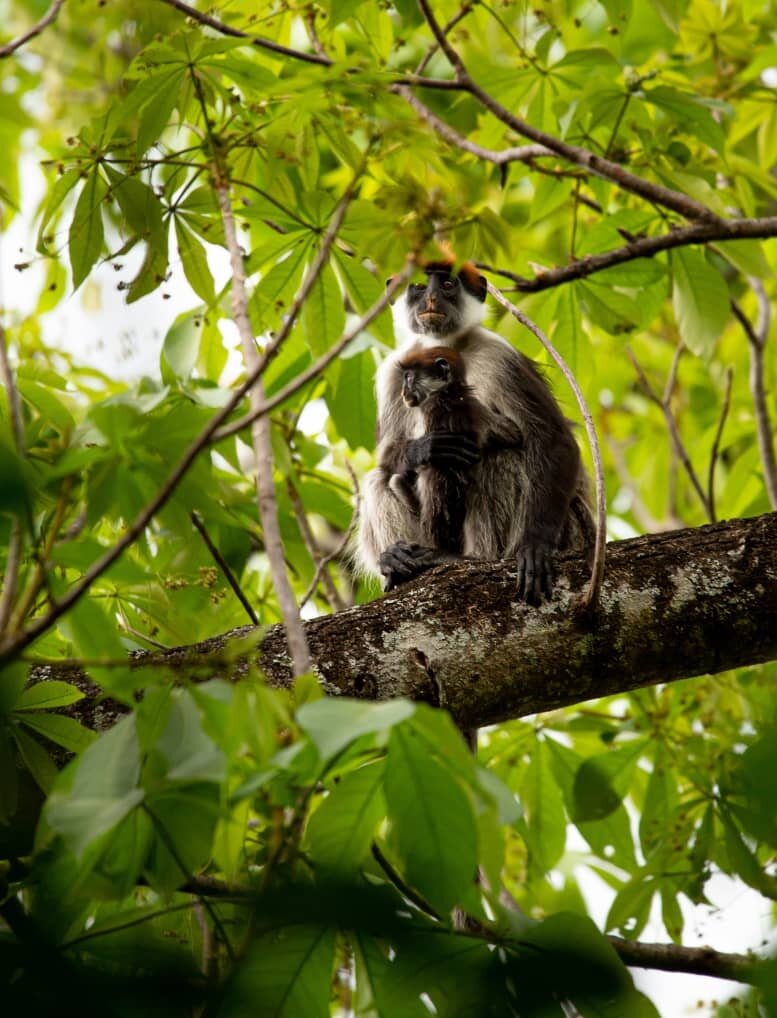
It matters because Magombera holds one of the healthiest Udzungwa red colobus populations outside the park, along with the Magombera chameleon and the Udzungwa dwarf galago.
The Udzungwa Corridor Reforestation Project
A separate initiative began in June 2021 at Mhanga village in Kilolo District, run by a private carbon credit company. The goal is to reforest a 7,500 hectare stretch of cleared land using only native species, restoring a corridor between the Kilombero Nature Forest Reserve, which covers over 134,000 hectares, and the Uzungwa Scarp Nature Forest Reserve at nearly 33,000.
Estimates put carbon removal at 4.5 million tonnes over thirty years. What matters ecologically is connectivity: two large protected forests linked rather than isolated, which allows wildlife to move between them. Most conservation funding globally goes to avoided deforestation rather than active replanting, so a project of this scale doing the latter is unusual.
Community Programmes Around the Park Boundary
TANAPA runs buffer zone programmes and shares tourism revenue with the villages along the boundary, and agroforestry work aims to build alternative resource bases so that people depend less on the forest itself. The park authority reports that surrounding communities have developed a positive attitude towards conservation as a result.
The Tanzania Forest Conservation Group, the largest national environmental organisation in the country, runs community development work across an array of activities including savings and credit cooperatives, primary schools and the planting of more than sixteen million agroforestry trees. At Magombera the arrangement goes further: part of every visitor’s entrance fee goes directly to local village communities, and joint management involves the Tanzania Forest Service alongside those villages.
What the Threats Actually Are
How Visitors Support Conservation Here
Park fees are the direct route. Conservation charges paid at the Mang’ula gate fund TANAPA’s management, ranger patrols and the community programmes around the boundary, which is worth remembering when you hand over a card at the office.
Beyond that, a Udzungwa hiking safari creates employment. Guides, rangers, porters and cooks are drawn from villages along this valley, and multi day treks employ a small team for several days at a time. The camp on the park boundary was built by a local workforce with the stated aim of raising awareness of the park and improving community livelihoods. Visiting Magombera sends part of the fee straight to the surrounding villages.
Research Still Being Done in These Mountains
The species list keeps growing. The kipunji was described from Ndundulu Forest in 2004 and placed in a genus of its own. The grey faced sengi was described within the last two decades. The Magombera chameleon was found in the forest in the two thousands and has seldom been seen since. At least one endemic snake has been recorded more recently still.
Camera trapping has produced most of what is known about the shyer mammals, and much of the range has never been surveyed on foot at all. Long term primate work has focused on habitat quality and its effect on population density in the red colobus and Sanje mangabey, both of which carry threatened listings.
Best Time to Visit and Support the Work
June through October is the practical window for most visitors, and it is when park revenue peaks. The wetter months carry lower visitor numbers, which means the same fee matters proportionally more to the local economy then.
Getting to Udzungwa and the Conservation Sites
The park headquarters and the monitoring centre both sit at Mang’ula, on the road between Mikumi town and Ifakara. Dar es Salaam is five to six hours away via Chalinze, Morogoro and the highway through Mikumi National Park, with graded dirt for the last 24 kilometres from Kidatu. Mikumi is around 60 kilometres north.
Magombera lies in the lowlands nearer that road, so it folds neatly into an arrival or departure day, and it has a well maintained flat trail of about five kilometres. Visits there need arranging in advance rather than turning up at the gate.
Frequently Asked Questions About Udzungwa Conservation
Where does my park fee go?
Conservation fees paid at the gate, currently 30 US dollars per non resident adult per 24 hours or roughly 35.40 with value added tax, fund TANAPA management, patrols and the buffer zone and revenue sharing programmes with boundary villages. Guide and ranger fees of around 20 dollars per day go to staff employment. At Magombera, part of the entrance fee goes directly to local village communities under the joint management arrangement.
Which organisations work in Udzungwa?
TANAPA manages the park itself. The Tanzania Forest Service manages adjacent nature reserves. Beyond government, the main players are the Udzungwa Ecological Monitoring Centre, the Udzungwa Forest Project led by Flamingo Land, Reforest Africa and the Tanzania Forest Conservation Group, with support from bodies including the World Land Trust, Rainforest Trust and WWF.
Can visitors volunteer or get involved?
Formal volunteering is limited and mostly aimed at researchers rather than short term visitors. The practical contribution is straightforward: pay the fees, hire local guides and porters, stay near the gate rather than day tripping, and visit Magombera where the fee structure directs money to villages. Donations to the named organisations are the other route.
Is the forest still shrinking?
Outside the park, yes, in places. Several lowland forest patches in the Kilombero Valley have been badly reduced or lost entirely in recent decades. Inside the park the boundary holds, though it is under steady pressure from farmland, logging, charcoal and fire. Restoration work is now adding forest as well, with corridor planting between the larger nature reserves.
Why is this forest treated as a global priority?
Because of what lives only here. Twenty vertebrate species are restricted to this mountain block alone, roughly a quarter of the 2,500 plant species are Eastern Arc endemics, and the range is listed as a world biodiversity hotspot and a globally important ecoregion. Species are still being described, which is rare anywhere.
Does tourism help or harm the forest?
On balance it helps here, because visitor numbers are low, all movement is on foot and revenue feeds directly into management and community programmes. The pressures on this forest come from land use around it rather than from the small number of people walking its trails.
Booking Your Udzungwa Trip
The safari companies and tour operators listed on this website put trips like this together for a living and know which camps, guides and routes actually deliver. We are an independent guide to Udzungwa; we do not book or sell tours ourselves.
When you are ready, arrange your safari, tour or holiday with one of the recognised operators listed here. Tell them your dates and what matters most, and a real person, not a form, will handle the itinerary, park bookings and logistics for you.