Rainforest Exploration in Udzungwa National Park
Rainforest exploration in Udzungwa Mountains National Park happens entirely on foot with a licensed guide, since the park has no interior roads, and covers forest running unbroken from around 250 metres to 2,576. It protects some 2,500 plant species, around 400 birds and twelve primates, two of which live nowhere else. Udzungwa sits in south central Tanzania and forms the largest block of the ancient Eastern Arc chain.
People arrive expecting a green backdrop and find something with structure, layers and a great deal going on that only becomes visible once you stop walking.
What This Forest Is Actually Like
Closed canopy, buttressed trunks, thick understorey and light arriving in patches rather than evenly. Humidity is constant and the air barely moves at low altitude, which is why visitors arriving from a dry savannah safari are soaked within an hour.
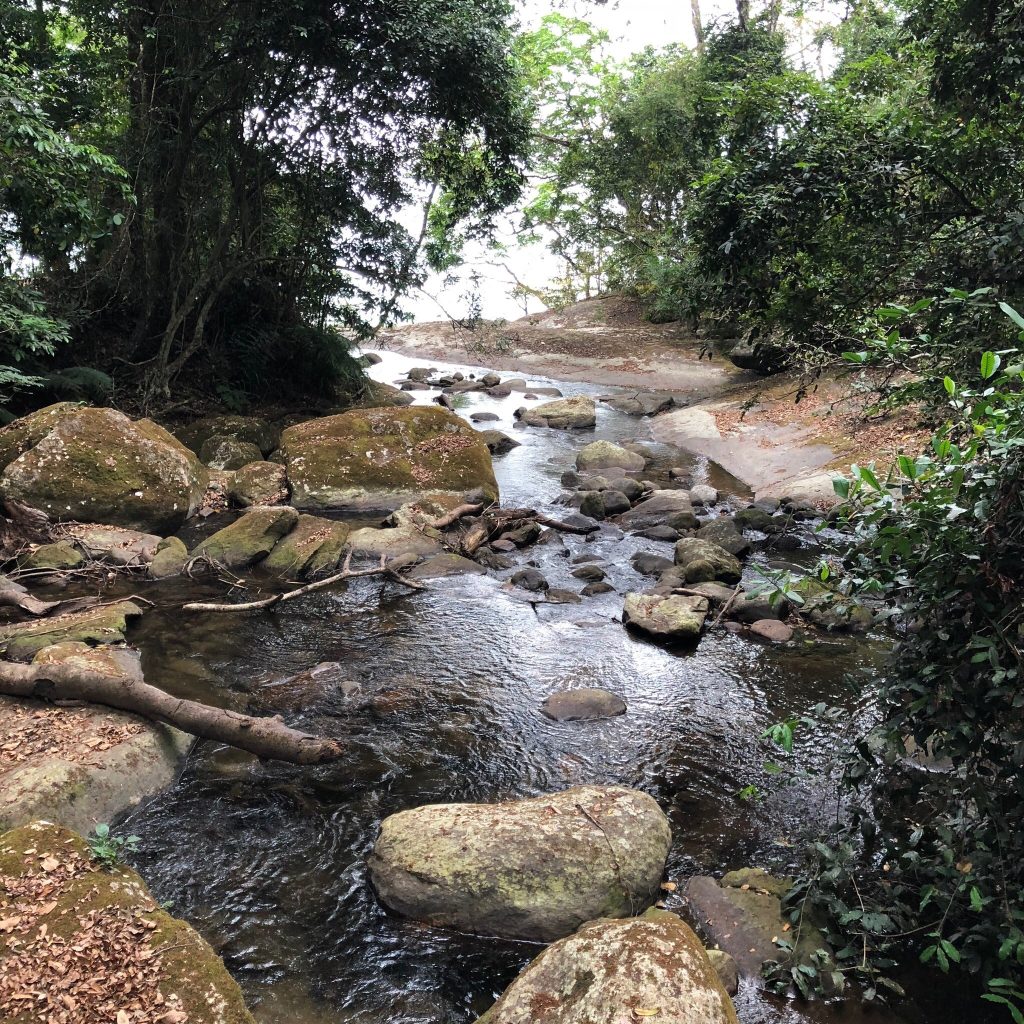
The floor is leaf litter, ferns crowd every stream bank, and moss covers fallen timber. Sound does more work than sight: hornbill wingbeats overhead, insects, something moving in the litter that has stopped by the time you turn your head. A rainforest walking safari here is less about covering distance than about learning to notice.
The Layers of the Forest and Where to Look
Everything worth seeing is arranged vertically. In the canopy, thirty metres up, colobus feed and hornbills cross. The mid storey holds greenbuls, green barbets and forest weavers, and blue monkeys move through it faster and lower.
The understorey is where duikers and bushbuck pass, freezing rather than bolting if you stop moving. On the forest floor, sengis rustle through leaf litter, and the Sanje mangabey forages at ground level as much as in the trees. Most first time visitors look straight ahead and see none of it. Guides spend their time directing eyes upward, then downward, then upward again.
Exploring the Forest by Altitude
The most interesting thing about this forest is that it changes as you climb, and it does so quickly. Miombo woodland at the lower edge is open brachystegia country with grass underfoot. Lowland rainforest takes over from around 300 metres. Submontane forest between roughly 800 and 1,400 metres brings moss, orchids and epiphytes.
Above that, montane forest is shorter and mist bound, then bamboo glades appear below the summit rock. The 38 kilometre Mwanihana trek crosses all of it over two or three days, which is a rare thing to be able to do on foot anywhere in Africa. Most tropical mountain forests survive only in high fragments, with the lowland belt long since cleared.
Guided Exploration on the Short Trails
You do not need a trek to understand this forest. Prince Bernhard, about a kilometre from the headquarters and under an hour return, passes through closed lowland forest at a pace that allows constant stopping, with red colobus overhead and baboons on the path.
The Sonjo circuit at three kilometres adds miombo woodland, which is a genuinely different habitat rather than more of the same. Both are gentle, both are covered by the same 24 hour permit as the longer routes, and both do more for a curious visitor than a hurried four hour climb to a waterfall.
What Guides Show You in the Forest
This is where the compulsory guide earns the fee rather than merely satisfying a rule. Guides trained through the park’s programmes name the medicinal plants used in the villages below and explain what each treats, knowledge passed down among the Hehe and Ndamba communities living along this valley.
They identify birds by call long before anyone sees one. They point out orchids on mossy trunks and wild African violets growing in their native range, which startles anyone who knows them as houseplants. And they know which stretch of canopy a colobus troop has been using that week, which is information no map carries and the main thing you are paying for.
The Forest at Night
The park does not run night walks as a standard product, and the forest after dark is worth experiencing anyway from wherever you are sleeping. Tree hyrax start calling once the light goes and carry a very long way, which startles first time visitors who assume something is in trouble nearby.
Six galago species live in this range, heard far more often than seen. Nightjars work the clearings. Trekkers camping on the Mwanihana route get the full version, and guests at the camp on the boundary get most of it from a chair. Ask your guide whether a short torch walk around the grounds is possible, since arrangements vary.
A Forest Still Being Catalogued
Exploration here is not purely a figure of speech. The kipunji was described from Ndundulu Forest in 2004 and given a genus of its own, the first primate discovery of that scale in over eighty years. The Udzungwa forest partridge was found in 1991 and turned out to have Asian relatives. A giant elephant shrew and at least one endemic snake have been described within the last two decades.
An ecological monitoring centre at Mang’ula has run standardised surveys and camera trapping since the mid two thousands, publishing checklists for the park’s mammals, birds and butterflies. Much of the range has never been surveyed on foot, and the invertebrate lists remain incomplete.
How to Explore Without Damaging It
Stay on the path, which matters more in forest than on open ground since the understorey takes years to recover. Take nothing: collecting plants or specimens inside a Tanzanian national park is prohibited without research permits arranged well in advance.
Keep voices low, stop when the guide stops, and give animals room when they cross the path rather than pressing closer. Never feed anything, and keep bags closed near the forest edge where baboons have long since worked out what a rucksack contains. The pressures on this forest come from land use around it rather than from walkers, and the fees you pay at the gate feed into buffer zone and community programmes.
Best Time for Rainforest Exploration
Every season shows a different forest. June through October gives the easiest walking and access to the upper bands. The long rains bring the whole system to full pace.
Exploring Forest Beyond the Park
The lowland forest at Magombera, below the mountains at the eastern foot of the range, protects over five hundred plant species on a flat five kilometre trail. It offers a different kind of exploring: level ground, shade, and red colobus relaxed enough after decades beside people to stay put rather than move off.
It works particularly well in the wet months when the mountain trails are hard going, and it puts money directly into the surrounding villages through its fee structure. Nearby, the wetlands along the Mang’ula road hold herons, kingfishers and two cisticola species tied to this valley, and the flat country around the village is easily covered by bicycle. None of it needs a park fee, and all of it fills the days when the escarpment is not cooperating.
Getting to Udzungwa to Explore the Forest
Register at the headquarters at Mang’ula on the road between Mikumi town and Ifakara. Dar es Salaam is five to six hours away via Chalinze, Morogoro and the highway through Mikumi National Park, with graded dirt for the final 24 kilometres from Kidatu. Mikumi is around 60 kilometres north and Iringa two to three hours southwest.
Staying at the camp on the park boundary puts you against the forest edge, where four primate species and over eighty bird species have been recorded in the grounds without anyone leaving the property.
Frequently Asked Questions About Rainforest Exploration
What does it cost to explore the forest?
The park conservation fee is 30 US dollars per person for 24 hours for non resident adults, roughly 35.40 with value added tax, plus a compulsory guide at around 20 dollars per day charged per guide rather than per head. Children between five and fifteen pay about 10 dollars. Multi day treks crossing the full altitude range run 400 to 500 dollars per person.
Can I explore the forest alone?
No. Every trail requires a licensed park guide and there is no self guided option anywhere. Beyond the rule, the paths braid and grow over between seasons, and elephant and buffalo range through the higher forest, which is why an armed ranger joins parties above a certain altitude.
How much of the park can visitors reach?
A small fraction. The established trail network totals a couple of hundred kilometres at most across a park of 1,990 square kilometres, all of it in the eastern strip near the gate. The interior has no paths and is reached only on expedition routes.
What will I see on a typical walk?
Two or three primate species on a half day, most often red colobus, Angolan black and white colobus and blue monkeys, plus hornbills, butterflies and forest birds. Duikers cross the path. Elephant sign appears on the higher routes. Nothing in a rainforest is guaranteed, and quiet groups see roughly twice what talkative ones do.
Is it uncomfortable walking in rainforest?
Humid rather than uncomfortable, and hotter at low altitude than most people expect. Quick drying clothing beats cotton, two litres of water is a minimum, and an early start avoids the worst of it. Higher up the air cools and the walking becomes genuinely pleasant.
Are there dangerous animals in the forest?
Elephant and buffalo on the plateau, which is why rangers accompany parties there. Leopard are present and almost never seen. There are no lions. Realistically the hazards are slippery roots, dehydration and losing the path, all of which the guide system exists to manage.
Booking Your Udzungwa Trip
The safari companies and tour operators listed on this website put trips like this together for a living and know which camps, guides and routes actually deliver. We are an independent guide to Udzungwa; we do not book or sell tours ourselves.
When you are ready, arrange your safari, tour or holiday with one of the recognised operators listed here. Tell them your dates and what matters most, and a real person, not a form, will handle the itinerary, park bookings and logistics for you.