Two New Toad Species Described From the Udzungwa Mountains
Two new species of toad from the Udzungwa Mountains were formally described on 6 November 2025 in the open-access journal Vertebrate Zoology. One of them, Nectophrynoides luhomeroensis, is named after the Luhomero Mountains inside Udzungwa Mountains National Park. The other, Nectophrynoides uhehe, is documented from the Uzungwa Scarp Nature Forest Reserve on the far side of the range.
A third species in the same paper, Nectophrynoides saliensis, comes from Sali Forest Reserve in the Mahenge Mountains, outside the Udzungwa block. The work was carried out by a team from the University of Copenhagen, the University of Dar es Salaam, MUSE in Trento, the Natural History Museum in London and other institutions, with Simon Loader as corresponding author.
Splitting a species that was never one species
For about a century, herpetologists applied the name Nectophrynoides viviparus to any toad in the genus with a large, robust body and prominent parotoid glands. That gave the species an improbably wide range, from the Southern Highlands near the Malawi border through the Udzungwa and Mahenge mountains to the Uluguru, Rubeho and Nguru ranges. Earlier molecular work had already suggested the populations outside the Southern Highlands were genetically distinct.
The 2025 paper resolves it by combining three lines of evidence: morphological and morphometric measurements from 257 specimens, bioacoustic recordings, and what the authors call museomics, meaning DNA recovered from archival museum specimens. That last step let them sequence the name-bearing type material collected in 1899 and 1900 and now held in Berlin, which is what pins the original name to the Southern Highlands population and frees the Eastern Arc populations to be named separately.
Toads that give birth to live young
Nectophrynoides are among the very few frogs anywhere that are viviparous. The paper notes that of 17 known viviparous species worldwide, 13 belong to this genus, and all of them are endemic to Tanzania. Before this description the genus held 13 recognised species; the three new ones take it to 16. The best-known member is the Kihansi spray toad, declared extinct in the wild in 2009 after a dam cut the flow over Kihansi Falls, and the subject of a long-running captive breeding and reintroduction effort.
The team also published Extent of Occurrence and Area of Occupancy figures for the new species and a revised identification key for the genus, which is the groundwork any future IUCN Red List assessment would need.
What it adds up to
The descriptions follow a familiar Udzungwa pattern. Luhombero, the highest ground in the range, and the remote western massif are among the least visited parts of the mountains and keep producing records that turn out to be new to science. The same is true of the range of ecosystems stacked up the escarpment, from lowland forest through submontane forest to montane grassland, which is what generates so much single-mountain endemism in the first place.
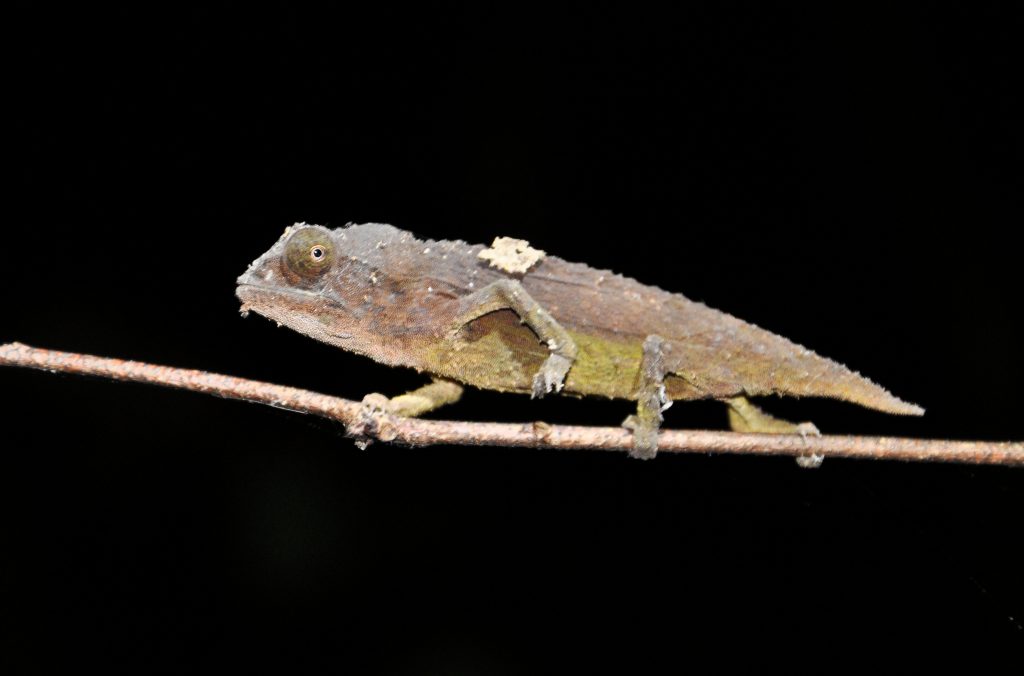
None of this is visible on a normal visit. Both Udzungwa species live at altitude in areas without tourist trails, and the toads are small, nocturnal and cryptic. What visitors can see on a night walk near Mang’ula are the more common frogs and chameleons, part of the endemic and near-endemic species the mountains are known for. Anyone wanting to reach the higher forest needs a multi-day trek with a park guide, and even then the herpetofauna is a matter of luck rather than itinerary.
For the forest itself, formal names are useful. As staff at the Udzungwa Ecological Monitoring Centre have pointed out in the past, a described species can be assessed, listed and argued over in a way an unnamed population cannot, and that has previously helped strengthen the case for protecting particular forest patches. It is one strand of the wider conservation effort here.
Sources
- Thrane, Lyakurwa, Liedtke, Menegon, Petzold, Loader and Scherz, “Museomics and integrative taxonomy reveal three new species of glandular viviparous tree toads (Nectophrynoides) in Tanzania’s Eastern Arc Mountains”, Vertebrate Zoology 75: 459-485, 6 November 2025
- Publisher record, doi:10.3897/vz.75.e167008