Sanje Mangabey Splits Into Two Lineages, 2026 Studies Find
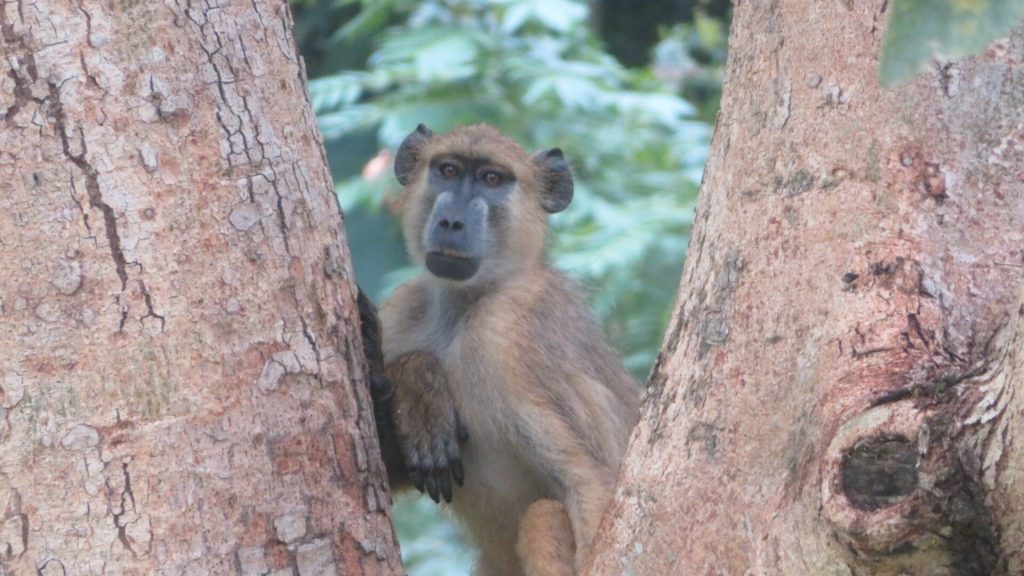
Two peer-reviewed studies published three weeks apart in April 2026 have concluded that the Sanje mangabey’s two surviving populations are not simply two halves of one group but distinct evolutionary lineages that separated around 770,000 years ago. Both papers recommend that the two populations be managed as separate units.
The first appeared in Primates on 10 April 2026 and used phylogeography and historical niche modelling. The second, in the International Journal of Primatology, was published on 27 April 2026 and placed the species within the wider Cercocebus family tree. Both drew on non-invasive DNA sampling, which means faecal and hair samples rather than capture.
What the studies found
The International Journal of Primatology paper reconstructed phylogenies from 88 nuclear and mitochondrial sequences and estimated that the Sanje mangabey split from the common ancestor it shares with the central and East African mangabeys about 2.34 million years ago, with a 95 per cent confidence interval of 1.73 to 2.95 million years. Within the species, the two populations diverged about 0.77 million years ago.
The Primates study worked from 64 mitochondrial control region sequences and found six haplotypes clustering into two haplogroups, with significant differentiation between the populations and no signal of recent range expansion or contraction. Its niche modelling, run for the Mid-Holocene, the Last Glacial Maximum and the Last Interglacial, suggests suitable habitat across southern Tanzania has expanded and shrunk repeatedly. The authors propose that intermediate populations died out as East Africa dried and montane forest retreated upslope, leaving two relict groups.
Two forests, 100 kilometres apart
The practical geography matters. One population lives in Mwanihana forest, on the eastern escarpment inside Udzungwa Mountains National Park and reachable from the Mwanihana trail above Mang’ula. The other lives in the Uzungwa Scarp Nature Forest Reserve, roughly 100 kilometres to the south-west, which is a separate protected area under Tanzania Forest Services rather than TANAPA. Visitors who go looking for Sanje mangabeys in the park are seeing only one of the two lineages.
Neither paper publishes a new population count, and neither claims the two groups are separate species. What they argue is narrower: that the populations qualify as candidate evolutionary significant units, a conservation category meaning they should not be treated as interchangeable. The International Journal of Primatology authors are explicit that further morphological, genetic and behavioural work is needed to assess how reproductively isolated the two are.
Why the label matters
The Sanje mangabey is listed as Endangered by the IUCN and is found nowhere outside these mountains, one of a short list of animals endemic to the Udzungwa range. If conservation planning treats the species as a single unit, effort can be concentrated wherever it is cheapest to deliver. If the two populations are managed separately, losing either one becomes an unacceptable outcome in its own right, and the Uzungwa Scarp population, in the less strictly protected of the two forests, gains weight in that calculation.
That distinction feeds directly into the conservation programmes running across the Udzungwa forests, several of which already work across both the national park and the scarp reserve. It also sharpens a point that applies to the whole primate community here: the Udzungwa Mountains are not one forest but a set of blocks separated by farmland, and the animals in them have been diverging for a very long time.
For anyone planning a trip, none of this changes what you will see. Mangabeys remain shy, ground-foraging and unpredictable, and the timing advice for primate viewing is unaffected.